/
/
Artemis Analytics Stablecoin Card Payments Breakdown 2026
The analytics team has revealed a research write up into the global adoption of physical stablecoin settlement, highlighting Visa stablecoin card supremacy.


Stablecoin payments have a fast growing category: stablecoin-linked cards (Aleksandr Popov / Unsplash)
The latest Artemis Analytics research into stablecoin cards is out. In the 2025 Artemis stablecoin report, it was highlighted how there were predominately 3 categories of stablecoin payments: B2B, B2C, P2P, pre-funding and via stablecoin-linked cards.
Well, it seems that stablecoin card payments are catching up pretty quickly, with a $18B annualised market and 106% CAGR (Compound Annual Growth Rate) vs. $19B P2P taking on a 5% between 2023 and 2025. To give a single sentence that highlights the sentiment:
Crypto cards are the infrastructure for the next phase of stablecoin adoption.
Let's take a closer look at the findings.
The Network King: Mastercard Stablecoin Card vs. Visa Stablecoin Card
Between the largest traditional payment networks, Visa currently dominates with 90% share of the stablecoin card payments. Both have 130+ partnering stablecoin card issuers.
However, it seems that Visa stablecoin card partnerships were geared towards more crypto native companies and startups such as Rain, Reap and others, whereas MasterCard chose a nuanced approach - CEXs (Centralised Exchanges) such as ByBit, Gemini and others.
Overall, Visa stablecoin card transactions contribute the most from the underlying data. Its partnerships appear to have a higher impact, especially since many new actual businesses are onboarded, who have their own customers, as opposed to CEX retail cardholders.
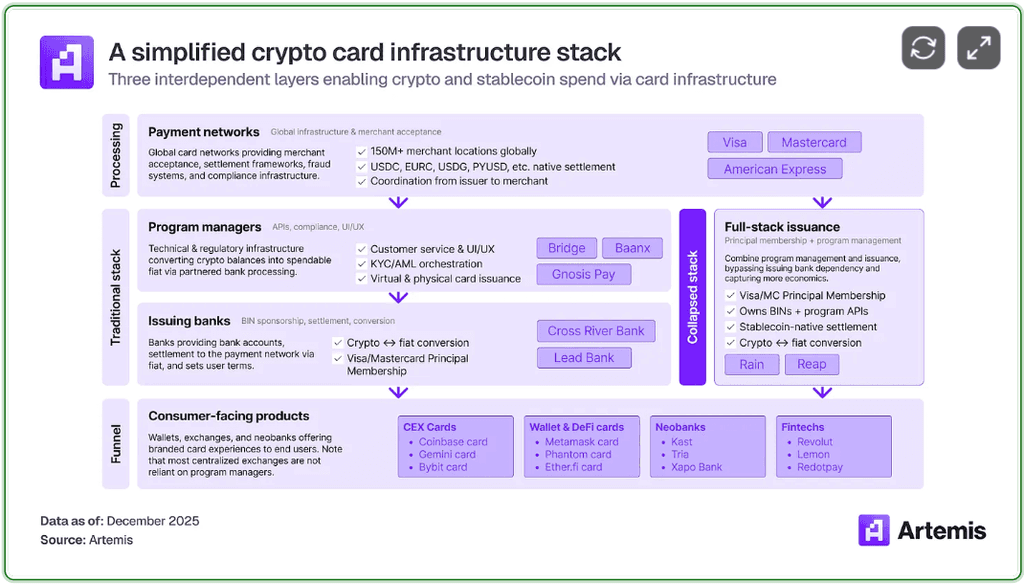
An overview of how stablecoin cards from Rain and Reap utilise the entire infrastructure for direct Visa membership, APIs, stablecoin settlement and conversion.
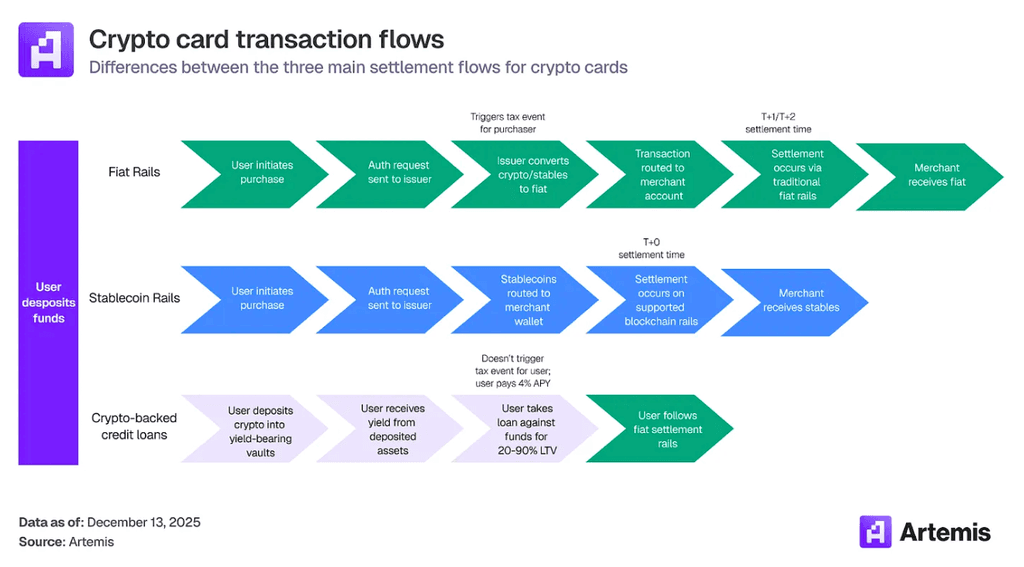
Here Artemis shows the benefits a stablecoin card settlement system has over traditional processes, saving both the number of intermediaries that are involved, as well as the settlement times.
Stablecoin Card Issuance And Trends:
The report presents a deep insight into the differences between the different card types, splitting it into 4 main categories: Centralised Exchange Cards (Coinbase, Crypto.com, …); Self-Custodial (Ethere.fi, MetaMask, …); Crypto NeoBanks (KAST, Offramp, …); and Fintech (Reolut, Chime, …). These vary between credit, debit and pre-paid stablecoin cards.
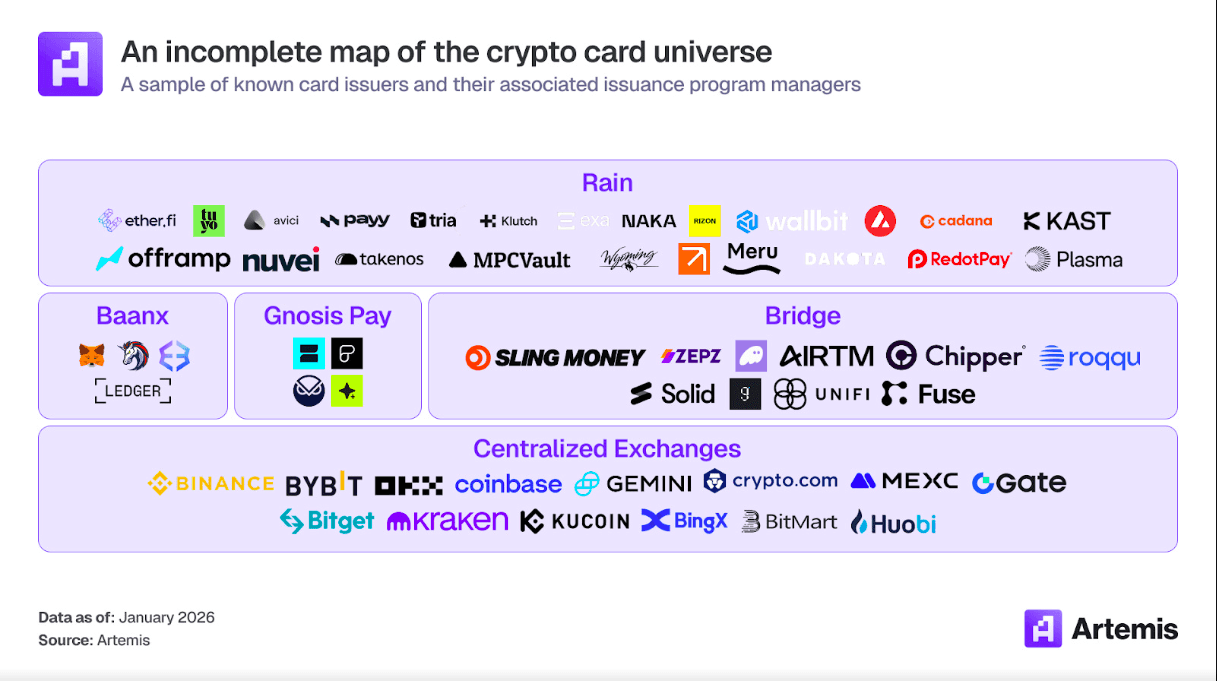
Not all stablecoin debit and credit cards are depicted here, but the ecosystem is expanding and providers are choosing their value prop deliberately.
For each one there certain product-defining features and tradeoffs, particularly but not limited to: FX conversion fees, native vs. partner fiat-to-stablecoin and stablecoin-to-fiat conversion, the type of stablecoin currencies offered, custody and security infrastructure, access to open stablecoin yield rates and DeFi protocols, as well as regional acceptance.
The research also dives into the revenue models for some of the top stablecoin cards. MetaMask mUSD stablecoin and Phantom's Cash stablecoin were highlighted in the context of offering a more sticky value-add for understanding stablecoin spending behaviour.
Also, there is a more flexible, DeFi integrated product offering from within a mobile stablecoin card payments app. Here, the argument is made that they have better monetisation opportunities vs. exchange-based cards that focus on distribution.
Now, as mentioned in their the 2025 Artemis stablecoin report, the regions do matter and depict various trends to consider. The top 5 regions for the adoption of USDC stablecoin card payments are: India, Argentina, Mexico, Nigeria and Uganda. All 48 countries shown throughout however, continue to have USDT as the dominant settlement stablecoin.
Key takeaways from the research:
Visa and MasterCard stablecoin cards have same number of partners
Visa's stablecoin transaction volumes result in a higher market share
Circle's USDC stablecoin more popular for stablecoin debit and credit cards
Tether USDT stablecoin cards are less common, but dominate regional flows
Ethereum, Solana and Base are common choices for stablecoin card issuers
Full-stack stablecoin card issuance is a rising business model
Exchange vs. self-custody vs. neo-banking is a ultimately user preference
Stablecoin card issuance and stablecoin issuance are not necessarily joined
Stablecoin credit card vs. stablecoin debit card debates are starting to emerge
AVAILABLE WHEREVER YOU ARE.
By signing up, you agree to our Privacy Policy
Note: This is intended for informational purposes only and does not in any way constitute or solicit financial, professional, or legal advice. Readers should conduct their own due diligence at all times.
Certain pages may have disclaimers above to distinguish between submitted press releases, AI-assisted and sponsored content, as well as Stablecoin News exclusives.